
Why Do I Need a Cannabis POS System?
Using a generic retail system at your Oklahoma dispensary creates compliance risk you may not see until an OMMA inspector does. Here's what a cannabis POS handles and why it matters.
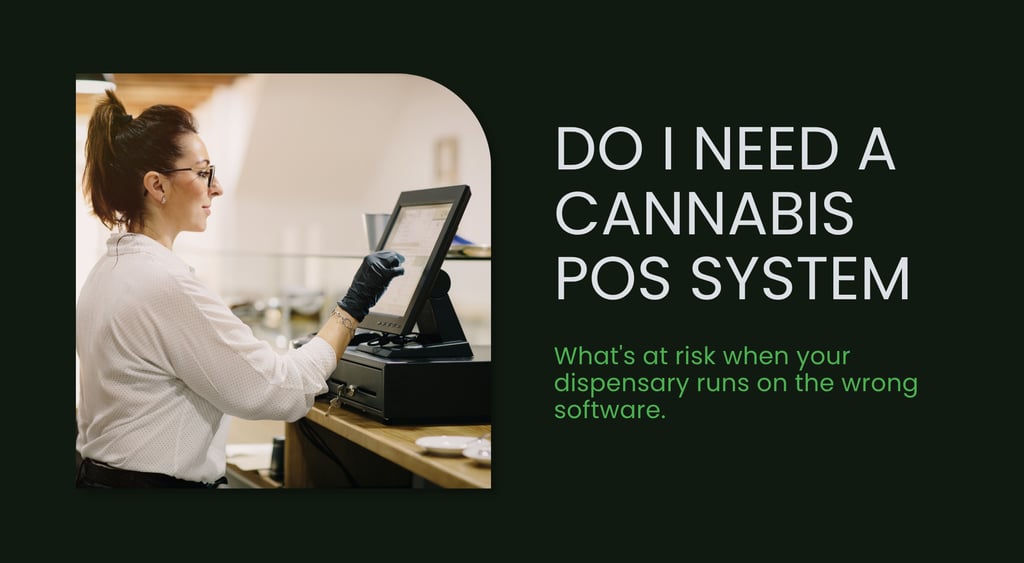
If you're running a dispensary in Oklahoma and still getting by on a generic retail system or a mix of spreadsheets, this question has probably crossed your mind at some point. A proper cannabis POS costs money. Switching is a headache. And if things are mostly working, the case for changing isn't always obvious.
But "mostly working" is doing a lot of heavy lifting in that sentence. Here's what's actually at stake.
Dispensaries are NOT Regular Retail
A clothing store does not need to report every sale to a state tracking system, but a dispensary does. Every transaction, transfer, and even package adjustment has to go into Metrc by law. When your POS wasn't built with that in mind, you're either doing a chunk of that compliance work by hand, or you're depending on an integration that connects your POS system and Metrc.
That gap is where most dispensary compliance problems start. Generic retail software was designed to move products and take payments. It wasn't designed to maintain the kind of audit trail an OMMA inspector expects to see.
The Data Mismatch Problem
Here's something worth knowing: most dispensary compliance violations don't come from fraud or serious negligence. They come from data mismatches. Your inventory count doesn't match Metrc. Day-to-day transactions can lead to data mismatches; for instance, a package gets sold, later gets returned through your POS, but Metrc still shows it sold.
These things don’t seem like a big deal in the moment. But they add up. By the time an OMMA inspection happens, you could be sitting on a backlog of discrepancies that takes hours to sort through and that an inspector might flag regardless of what actually happened. There are real cases in Oklahoma where inventory discrepancies have put dispensary licenses at risk over errors that started exactly this way.
A cannabis POS built for compliance handles the Metrc connection differently. Instead of routing data over after the transaction, a Metrc-native system has compliance integrated into how it processes each transaction from the start.
Someone On Your Team Is Paying with their time
Even when things are technically working, there's usually someone spending time keeping them working. Basic tasks like manual reconciliation, checking that your numbers match what Metrc is showing, all take up considerable time, and they need fixing before it becomes a bigger issue.
In most dispensaries that work tends to fall on whoever has the highest level of access and the most institutional knowledge. Mostly a manager, or sometimes the owner. And it doesn't take long before it's a daily routine that nobody signed up for.
A lot of the tasks that eat up dispensary staff time exist specifically because the software isn't doing what it should be. When your POS is built around compliance, a lot of that manual work goes away or at least shrinks significantly.
What a Cannabis POS Actually Does
A cannabis-specific POS in Oklahoma is covering a lot more ground than a standard retail system. The main things:
Real-time inventory tracking that stays in sync with Metrc, so your counts are current and there's no gap between what you have and what the state sees.
Package-level tracking across every product. When something moves, transfers, gets split, or gets sold, it records in a way that matches OMMA's requirements.
Reconciliation that catches discrepancies the day they happen, before they pile up into something harder to explain.
Reporting that's audit-ready, so when you need documentation quickly, everything is accessible
Oklahoma-specific compliance logic built into the workflow.
Does It Actually Pay For Itself?
Worth thinking through honestly. A compliance fine in Oklahoma can range from a warning to license suspension depending on what the violation looks like. One serious fine costs more than a typical software subscription for the year. Add in the staff hours going toward manual reconciliation, the manager time spent chasing errors, and the general lag because of data entry tasks like inventory, logging; and the math starts to look different.
A cannabis POS that handles compliance correctly isn't really an added expense. It's the infrastructure that makes everything else faster and more accurate.
If you're trying to figure out what to actually look for before committing to a system, this cannabis POS evaluation guide gets into how you can select a POS for your dispensary.
OMMA Inspections Don't Come With a Warning
You probably know this, but it's worth saying again. OMMA can show up with limited notice and ask to see your inventory records, transfer logs, and reconciliation reports. If your documentation is clean and current, it's a routine visit. If it isn't, it gets more complicated from there.
This is why your cannabis compliance software and POS really should be the same system. Running them separately means your data has to move between two platforms, and that often leads to sync errors.
Frequently asked questions
Can I use a general retail POS for my Oklahoma dispensary?
You can, but it means taking on compliance risk that's largely avoidable. General retail systems aren't built around Metrc, so you end up managing that connection yourself or through an integration that may not stay current with OMMA requirements.
Do I need separate software for compliance and POS?
Running them on separate platforms creates data gaps. One system that handles both is easier to manage and more reliable when you need to pull documentation in a hurry.
Will switching POS systems disrupt my operations?
There's a transition period, yes. But it's temporary. The compliance risk of staying on a system that can't keep up with OMMA requirements is ongoing.
What's the difference between Metrc integration and Metrc-native?
Integration means a system connects to Metrc after the transaction, usually via API. Metrc-native means Metrc is part of how the system was built from the start. The native approach is more stable and less likely to produce sync errors.
How do I know if my current system is creating compliance risk?
The clearest sign is regular manual reconciliation. If someone on your team is routinely cross-checking your POS against Metrc by hand, your system isn't handling that connection the way it should.
Not sure if your current setup is putting you at risk?
A free compliance check gives you a clear picture of where things stand, no commitment required.
Check Out Our Recent Blog Posts
© 2026. All rights reserved.
Metrc-native cannabis software for OMMA-licensed operators. Built in Oklahoma, built for compliance.